
How to Choose DJ Speakers
Match speakers to room, audience and use rather than chasing wattage numbers.
The short answer
Match speakers to room, audience and use rather than chasing wattage numbers. The right choice depends on your equipment, intended use and how much complexity you actually need.
Start with the room, not the wattage
Think about where the speakers will be used, how far listeners will be from them and whether you need home monitoring or event coverage. Powered speakers simplify many beginner setups because amplification is built in, but inputs, weight, stand mounting and usable headroom matter just as much as headline power figures.
Do not compare speakers by watts alone
Two speakers with similar wattage claims can behave very differently. Look at intended use, maximum SPL, driver size, connection options and the manufacturer’s coverage information, then choose a system that can operate comfortably rather than permanently at its limit.
Plan the whole speaker system
Add the cables, stands and transport requirements to the speaker price. For mobile use, also decide whether you genuinely need a subwoofer now or whether a pair of capable tops is the more useful first purchase.
Choose between nearfield listening and room coverage
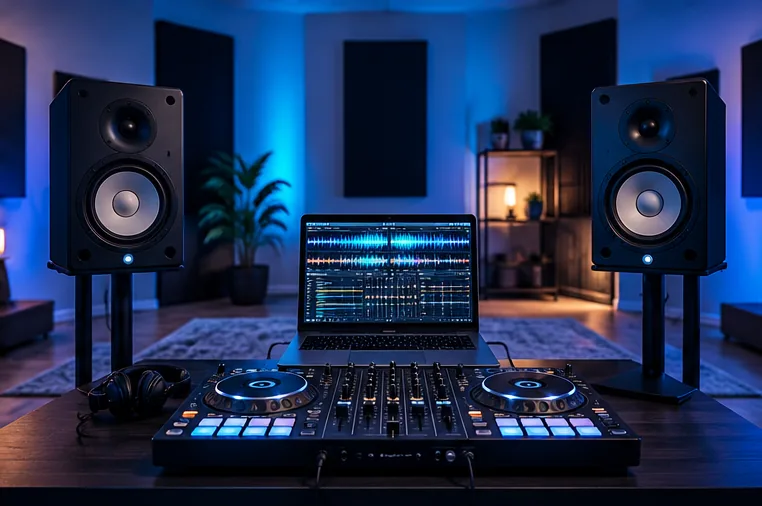
Bedroom monitors are designed to be heard from a short distance. They make sense when you are sitting or standing close to the speakers and want clear detail at sensible volume. A PA speaker has a different job: projecting sound across a room and staying controlled when the audience, room size and background noise increase.
If you need one system for both jobs, be realistic about the compromise. A compact PA can work at home at low level, but it will not behave like a small monitor on a desk. Likewise, a pair of monitors can sound excellent nearby but should not be expected to cover a busy party.
Check the connections before comparing brands
Look at the master outputs on your controller or mixer and the inputs on the speakers. RCA is common on beginner equipment; balanced TRS or XLR becomes more useful when cable runs get longer or when the setup moves into event spaces.
Also check whether the speakers are powered or passive. Powered speakers contain their own amplification. Passive speakers need a suitable amplifier, which changes the cost, cabling and transport plan. Buy the system you understand how to connect, not simply the model with the largest number on the specification sheet.