
VirtualDJ: from first mix to your first gig
An independent guide to VirtualDJ, its licences, supported DJ controllers, sound routing, music preparation and performance tools.
What is VirtualDJ?
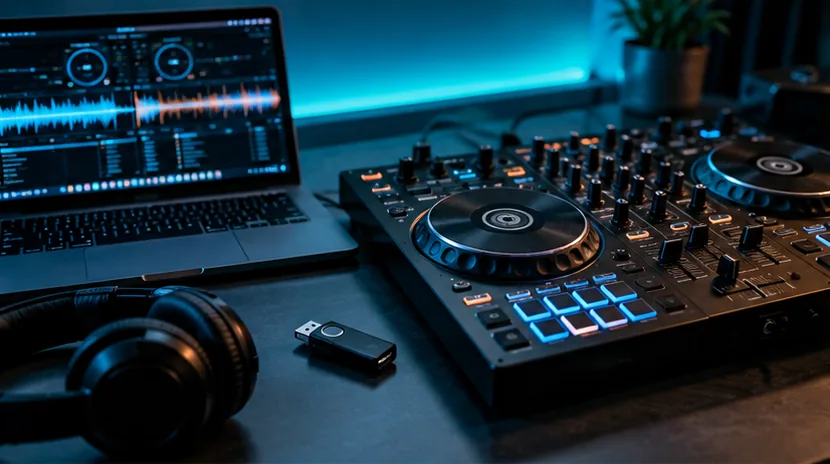
VirtualDJ is software for mixing tracks on a computer, with support for onscreen controls, compatible hardware, music-library tools, creative effects and more. You can begin practising without buying hardware, or connect a supported DJ controller and use the appropriate licence. Its official manuals also document audio and video recording, karaoke/video workflows and stem separation.
For FirstFader readers, there are two particularly important questions: can my controller run it? and which licence do I need? A controller listed as supported is not necessarily unlocked for unlimited use by the Free licence.
Explore VirtualDJ step by step
Start with the basics
Install VirtualDJ, prepare two tracks, check audio routing and make a first mix with or without a DJ controller.
Open guide →Licences and pricing
Understand VirtualDJ Free vs Home vs Pro, controller restrictions, the 10-minute demo and licences for paid gigs.
Open guide →Check controller support
Find VirtualDJ-compatible controllers, including DDJ-FLX2, FLX4 and DDJ-400, and check drivers and required licences.
Open guide →Fix your headphone cue
Troubleshoot silent headphones, wrong audio devices, missing cue output and software/controller routing in VirtualDJ.
Open guide →Plan your first gig
Prepare VirtualDJ for a live event with professional licensing, offline music, tested audio routing and a backup plan.
Open guide →Explore stems
Learn what VirtualDJ stems separate, how stem pads work and when to prepare tracks ahead of a gig.
Open guide →Hardware used by real DJs
VirtualDJ publishes model-specific setup pages for beginner hardware such as the AlphaTheta DDJ-FLX2 and Pioneer DJ DDJ-FLX4, and for used favourites such as the Pioneer DJ DDJ-400. It also supports some larger four-channel systems, subject to their own licences and drivers. Always confirm the exact model rather than assuming all devices from one manufacturer work alike.
What can you learn without spending more money?
Without a controller, you can begin learning deck loading, tempo matching, phrase recognition and simple mixing using the personal Free workflow. A controller helps with physical cueing and mixer control, but it is not a shortcut to good timing or musical judgement. The first challenge is hearing where one musical phrase ends and the next begins.
Try two tracks with similar BPM, set a cue point, line up the start of a phrase and make a simple crossfade. Once that works reliably, learn separate headphone cueing, beatgrids and EQ. Our no-controller guide starts with the least expensive setup.
Where VirtualDJ extends into event work
The official documentation includes stems, recording, video and karaoke functions. Those can matter to mobile DJs, but paid work adds practical responsibilities: a professional licence, lawful music use, dependable offline tracks, tested microphones and backups. Read the gig checklist before accepting bookings.
All VirtualDJ tutorials
VirtualDJ for Beginners: Your First 20-Minute Setup
Install VirtualDJ, prepare two tracks, check audio routing and make a first mix with or without a DJ controller.
Read guide →Is VirtualDJ Free? Free, Home and Pro Licences Explained
Understand VirtualDJ Free vs Home vs Pro, controller restrictions, the 10-minute demo and licences for paid gigs.
Read guide →Which DJ Controllers Work With VirtualDJ? A Compatibility Checklist
Find VirtualDJ-compatible controllers, including DDJ-FLX2, FLX4 and DDJ-400, and check drivers and required licences.
Read guide →Using the DDJ-FLX4 With VirtualDJ: Setup, Audio and Licences
Connect a Pioneer DJ DDJ-FLX4 to VirtualDJ, select speaker and headphone outputs and understand licence requirements.
Read guide →VirtualDJ Headphones Not Working? Fix Cue and Master Audio
Troubleshoot silent headphones, wrong audio devices, missing cue output and software/controller routing in VirtualDJ.
Read guide →VirtualDJ Stems for Beginners: Vocals, Drums and Practical Mixing
Learn what VirtualDJ stems separate, how stem pads work and when to prepare tracks ahead of a gig.
Read guide →Organising a DJ Music Library in VirtualDJ
Create searchable folders, lists and reliable backups in VirtualDJ before moving from bedroom practice to gigs.
Read guide →How to Record Your First DJ Mix in VirtualDJ
Record a VirtualDJ practice session, choose a suitable audio format and check master-output and microphone routing.
Read guide →VirtualDJ Video Mixing and Karaoke: What a New DJ Needs to Know
An introduction to VirtualDJ video and karaoke capabilities, external displays and reliable event preparation.
Read guide →Buying a Used DJ Controller for VirtualDJ: What to Check
Avoid licence and driver surprises when buying a second-hand controller for VirtualDJ; checklist with DDJ-400 and FLX4 examples.
Read guide →VirtualDJ for Your First Paid Gig: Licence, Audio and Backup Checklist
Prepare VirtualDJ for a live event with professional licensing, offline music, tested audio routing and a backup plan.
Read guide →VirtualDJ vs rekordbox, Serato and djay: Choosing DJ Software
Compare VirtualDJ, rekordbox, Serato and djay for home practice, controller compatibility, mobile use and first gigs.
Read guide →Can You DJ With VirtualDJ Without a Controller?
Learn to practise on VirtualDJ with a laptop, a local music library and onscreen decks before buying hardware.
Read guide →Official sources and further reading
These original software-provider resources support the instructions above. Features, licensing and compatibility can change; check the latest version and your exact hardware before making a purchase or playing a gig.
- VirtualDJ licence and price comparison ↗
- VirtualDJ Home licence details ↗
- VirtualDJ supported hardware directory ↗
- VirtualDJ official user manual ↗
- VirtualDJ audio routing and headphones ↗
- VirtualDJ stems 2.0 and performance guidance ↗
- VirtualDJ mix recording instructions ↗
- VirtualDJ layouts, video and karaoke interfaces ↗